

You’ve probably never even considered how air pollution could have an economic impact. But it’s true! Every year, over $8 trillion dollars is spent globally on healthcare and other costs related to air pollution. It’s mind boggling. The good news is that investing in clean air solutions, such as premium air purifiers like Alen that enhance indoor air quality, is the first step toward a future of breathing cleaner air. Let’s first look at the big picture of air pollution’s financial tolls.
The Economic Cost of Air Pollution
Many countries spend billions of dollars each year as a result of air pollution. How does it add up to so much? Healthcare costs and lost work days account for the lion’s share. Hang tight, we’re about to spell it all out.
Medical costs due to air pollution
There’s no disputing that air pollution results in huge healthcare costs. In the United States, for instance, air pollution-related health costs are approximately $2,500 per person annually. Why is that? Think about the hospital admissions, medications, and long-term treatment for conditions like asthma and cardiovascular diseases. These health issues are associated with air pollution, according to the Environmental Protection Agency (EPA). Not all countries, of course, have the same impact. Research shows that China and India are particularly affected. The costs of PM2.5 pollution—a widespread and microscopic air pollutant—are estimated at over 10% of GDP in these countries. Who knew?
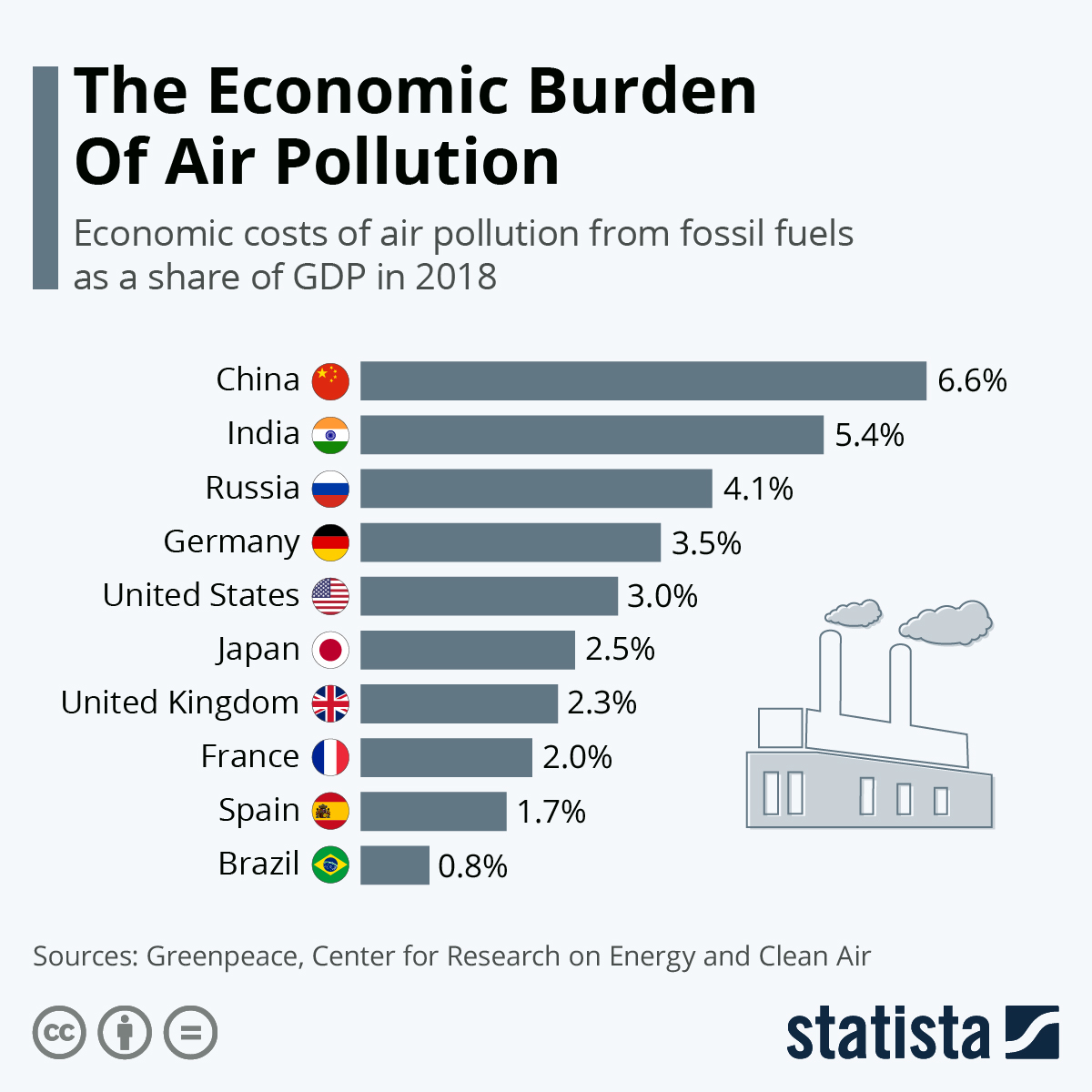 You will find more infographics at Statista
Workplace productivity takes a hit
How does air pollution affect where we work? Well, workers aren’t as productive because they’re tired and can’t focus as well. As a result, sick days are used more often. Not surprisingly, these effects especially impact highly populated areas with lots of pollution. For instance, India lost 1.3 billion working days due to air pollution-related absenteeism in 2019, costing the economy approximately $6 billion.
Other research from the Harvard T.H. Chan School of Public Health confirms that poor indoor air quality (IAQ) affects response times and focus, further affecting productivity. Since most employees work indoors, good quality IAQ is important for workplace health and efficiency.
Pollution-Related Absenteeism Costs U.S. Businesses Over $150 Billion Annually
Hidden Economic Losses That Go Unnoticed
What may not be readily apparent is that air pollution has other, less noticeable economic impacts. Think about it as a ripple effect that you might not immediately associate with air pollution. These less visible impacts can lead to long-term losses for families and communities—including children, crops, and property values. Let's break it down.
Childhood development
Just imagine how children are impacted by air pollution. Research has shown that early exposure to air pollution is linked to impaired brain development, memory issues, and increased absences from school. Another study published in Environmental Health Perspectives estimates that air pollution contributes to some 16,000 premature births annually in the United States. These premature births resulted in over $4 billion in economic costs due to medical care and lost productivity. Unfortunately, developmental challenges for these children can have lifelong impacts.
Real estate values
Would you hesitate to live or work in an area with high air pollution? You’re not alone. As awareness of environmental health risks and air pollution grows, people increasingly value air quality when selecting homes and workplaces. Not surprisingly, most people have shown they don’t want to live in a polluted neighborhood, resulting in lost value for homes and commercial properties. There is some good news, though. Studies have shown that improvements in air quality can lead to an increase in housing prices. For instance, research found that reductions in total suspended particulates (TSPs) due to the Clean Air Act led to a 4-5% increase in housing prices in affected areas. So, clean air initiatives do help!
Food supply
Ever thought about the effect of air pollution on crops? Polluted air, particularly ground-level ozone, harms crops. Ozone is actually toxic to plants. Unfortunately, it damages plant tissues, leading to stunted growth. In the United States, for instance, current ozone levels can decrease yields of popular and prominent crops like wheat, soybeans, and cotton by 5-15%. As you might imagine, greater impacts are expected if ozone levels continue to rise.
Here’s the cause and effect—air pollution causes rising food prices and losses for farmers, which impacts local areas and the amount of food available worldwide. East Asia loses $63 billion annually in crops due to ozone pollution, with China losing about one-third of its potential wheat production and one-fourth of its rice production.
Wider Economic Disruption at the National Level
Air pollution doesn’t just impact individual health—it disrupts entire economies. It’s a hidden yet powerful hit on a nation’s economy. Let’s get to the nitty gritty.
Air pollution’s drag on GDP growth
Air pollution is a major stumbling block to nations growing their economies. According to the World Bank, constant exposure to air pollution reduces worker productivity and increases death rates, costing trillions of dollars across the globe. The effects are even greater in countries with dense populations like China and India, where losses were about 12.9% of GDP due to fine particulate pollution. What's the good news? Investing in clean air can help make up for these losses. World Bank projections, for example, show air quality improvements could generate up to $2.4 trillion in economic gains by 2040.
Public resources spread thin
Air pollution forces governments to spend billions of dollars on healthcare, emergency response, and cleaning up the environment. In the United States, studies show the annual cost of pollution-related health expenses exceeds $820 billion. That’s a ton of money! These expenses often take resources away from education, infrastructure, and innovation. Again, research shows that investing in clean air pays off—pollution control can deliver up to 30 times the return in economic benefits. Clean air isn’t just healthier—it’s a smarter use of public funds.
Investing in Clean Air Makes Financial Sense
Investing in clean air solutions isn't just a goal to enhance people’s health—it's an economic investment with substantial returns. Research indicates that every $1 spent on air pollution control yields approximately $30 in economic benefits—specifically, in reduced healthcare costs and increased productivity at work. The U.S. Clean Air Act has been associated with significant economic benefits, including preventing premature deaths and reducing respiratory illnesses, contributing to a stronger economy.
What are some immediate steps to take? Indoor air quality can be improved, particularly in urban areas, regions prone to wildfires, or locations with high traffic pollution. But how? An effective solution is the widespread use of home air purifiers, which effectively deliver cleaner indoor air. Alen air purifiers, for instance, remove 99.9% of airborne particulates indoors as small as 0.1 micron. Cleaner indoor air means fewer sick days, sharper focus, and better overall health. These improvements add up, helping people breathe more easily and focus better, contributing to a healthier workforce. Clean air is a building block for a better future.
FAQs
1. How much does air pollution cost globally each year?
Air pollution has a significant impact on the global economy. The total cost of health damages caused by air pollution reached $8.1 trillion in 2019—approximately 6.1% of global GDP, according to the World Bank. These costs include hospitalizations, managing chronic disease, and incurring lost productivity, making air pollution one of the most expensive public health and economic challenges.
2. Can air purifiers help lower healthcare costs?
Yes, air purifiers can play a role in reducing personal and national healthcare costs. By filtering out harmful pollutants like PM2.5, allergens, and smoke indoors, air purifiers can help prevent respiratory issues, reduce asthma flare-ups, and improve overall wellness. Studies show that even modest reductions in indoor air pollution can lead to fewer doctor visits, reduced medication use, and lower risk of long-term chronic conditions.
3. Is indoor air really worse than outdoor air?
Yes, indoor air can be worse than outdoor air. The EPA reports that indoor air can be 2 to 5 times more polluted than outdoor air—and sometimes up to 100 times worse. Cooking, cleaning products, pets, and furniture off-gassing all contribute to indoor pollution. Because people spend up to 90% of their time indoors, improving indoor air quality is critical for protecting long-term health.
Sources:
- https://www.weforum.org/stories/2021/06/air-pollution-cost-america-healthcare-study/
- https://www.epa.gov/air-research/air-pollution-and-cardiovascular-disease-basics
- https://openknowledge.worldbank.org/server/api/core/bitstreams/550b7a9b-4d1f-5d2f-a439-40692d4eedf3/content
- https://www.statista.com/chart/20804/costs-of-air-pollution-from-fossil-fuels/
- https://www.cleanairfund.org/wp-content/uploads/01042021_Business-Cost-of-Air-Pollution_Long-Form-Report.pdf
- https://hsph.harvard.edu/news/office-air-quality-may-affect-employees-cognition-productivity/
- https://www.cdcfoundation.org/pr/2015/worker-illness-and-injury-costs-us-employers-225-billion-annually#:~:text=The%20Centers%20for%20Disease%20Control,States%2C%20or%20$1%2C685%20per%20employee.
- https://www.sciencedirect.com/science/article/abs/pii/S016622362400122X#:~:text=A%20growing%20body%20of%20human,on%20timing%20and%20brain%20region.
- https://ehp.niehs.nih.gov/doi/10.1289/ehp.1510810
- https://time.com/4274355/air-pollution-preterm-birth/
- https://www.nrcs.usda.gov/sites/default/files/2022-10/Ozone-Research-Review.pdf
- https://phys.org/news/2022-01-ozone-pollution-asia-billions-lost.html#:~:text=Ground%2Dlevel%20ozone%20is%20significantly,Asia%2C%22%20he%20told%20AFP.
- https://theaseanpost.com/article/ozone-pollution-costs-asia-billions-lost-crops
- https://www.worldbank.org/en/news/press-release/2025/03/27/cleaner-air-is-within-reach-by-2040-new-report
- https://www.bc.edu/bc-web/centers/schiller-institute/sites/masscleanair/articles/econ.html#:~:text=Recent%20estimates%20find%20that%20every,and%20reduced%20health%20care%20costs.
- https://www.bc.edu/bc-web/centers/schiller-institute/sites/masscleanair/articles/econ.html
- https://www.epa.gov/clean-air-act-overview/clean-air-act-and-economy#:~:text=Today%2C%20as%20in%20the%20past,become%20a%20global%20market%20leader.
- https://www.epa.gov/report-environment/indoor-air-quality


